Category Archives: Marketing
SmartCloud leads IBM to dethrone Microsoft on CNN’s “Four Horsemen of Tech” list
The times, they are a’changin’! In the shifting sands of technology, IBM is proving to be the Rock of Gibraltar.
CNN Money just conducted their annual survey of technology and investment experts to determine which 4 technology companies are the best investments in the industry. Apple, Amazon, Google, and IBM are what they describe as “The Four Horsemen of Tech”.
Microsoft and Dell are no longer on that list. And as recently as 2 years ago Research in Motion might have been expected on that list. The CNN article describes the changing of the guard is due to the shift from PCs to mobile and cloud solutions. I think it goes deeper than that.
Apple, Amazon, and Google are all following the same track that led Microsoft to its fame and glory days by riding the fast-but-fickle success opportunities provided by the consumer market. They are simply the latest fashion trends. In this list of top performers, IBM is the dark horse, being the only one not involved in consumer products whatsoever. They also just celebrated their 101st birthday this year. Coincidence? I don’t think so.
Rides on the consumer wave are relatively short. Google is 16 years old, Amazon is 18 and Apple is 36, though Apple’s great surge came in the last 6 years starting with the introduction of iOS. For reference, RIM and Dell are 28 years old and Microsoft is 37 and they are already declining. They too, based their success heavily on consumer products and are now feeling the consequences. Yes, RIM’s BlackBerry is intended to be a business tool, but it is a consumer device first and foremost. It is considered even more personal than a personal computer (PC). One might argue that Microsoft also makes software for business, but their primary focus has always been on consumers and their foray into the business product market has depended on consumer-driven brand recognition. Also, because many of their products service both business and consumer needs, they are driven by consumer markets. (See RIM.)
Similarly, the focus that led 3 of the current Four Horsemen to their place in the lineup has a consumer emphasis: mobile devices and advertising. Apple’s iPhone and iPad redefined mobile. Google has Android devices and search (advertising). Amazon is into selling (and advertising) along with the Kindle for a mobile presence. All of them are also dabbling in cloud services for businesses. Then there is IBM, the seasoned veteran of business solutions. What makes them part of this leadership crowd? I isn’t just for their SmartCloud solution, I think it is the fact that they have stayed true to their earliest beginnings. Unlike all of the other players, IBM has focused their attention, with laser beam precision, on the proven stable base of the business market.: They provide business solutions for businesses. IBM has resisted the temptation to cross the line into the consumer market, even at the urging of experts and loyal customers who pushed to have Lotus Notes repackaged for consumers. Doing so in the short term would certainly win consumer approval and thus fend off the consumer-led push for the Microsoft Outlook mail client to be used at both work and home. But that would have forced IBM to chase the whim and fads of consumers rather than staying focused on long-term needs of businesses.
When it comes to technology, IBM is all business.
I predict we will see a rise and fall of all 3 of the consumer-driven horsemen in CNN’s list, replaced with 3 new ones as the what’s-hot list changes. I also predict that IBM, with it’s exclusive commitment to serving up business solutions, will continue to stand at or near the top as it has for decades. For consumer products, you shouldn’t care. But for your business, it matters.
A critical lesson in customer service, connections and social media
First, if you need help with a printer and you live in the Seattle area, I highly recommend the services of Infinity Communications. Ask for Mark.
But this story isn’t about printers, that’s just where it all starts. I have an old HP Laserjet 4000 printer. The manufactured date is April 15, 1998. A classic. It’s 44 pounds of metal and only 1 pound of plastic. Definitely Old School. I in inherited it along with an extra toner cartridge refill several years ago when our office was getting rid of it to replace it with a fancy new multi-function printer.

It has served me well, but recently the sheet feeder started jamming. The printer only worked if I fed paper one page at a time into the manual tray. I decided to get rid of this old laser printer along with my color inkjet printer and a flatbed scanner and replace them with a modern all-in-one printer from Costco. This new machine is great. It scans, prints color photos, makes copies, send faxes via the Internet, and even allows me to print from anywhere via facebook. Not to mention all the desk space it freed up.
On Monday, less than three months since I bought it, it ran out of black ink. That same day, as if they already knew I would need it, I got an email from Costco advertising their printer cartridge refill service for about $10. (Perhaps the printer has a feature to alert Costco when the toner is low. It is certainly capable of it and if Target can predict you are pregnant by your buying habits, then Costco could certainly be monitoring printer alerts.)
I got it refilled, but I also thought back on that old laser printer sitting by the door, waiting to be disposed of properly. It was such a workhorse. It should be good for a few more years of printing at least, if only the automatic sheet feeder worked.
But like I said, this story isn’t about printers. It’s about people. It’s about customer service, connections and social media.
I decided to call around and see what it would cost to get it repaired. I consulted the great oracle, Google, who guided me to a long list of companies in my area that service printers. The first one I called answered promptly. The woman at the other end was helpful and knowledgeable. When I mentioned what printer I had, she replied “ah yes, that is considered the old workhorse of printers! There are many still in service today.” She went on to explain the cost for repair is $25 for the visit (they come to you) plus $75/hour. It should take under 1 hour. And I may want to get the maintenance kit which is $300 parts and labor. That would be about $400 total. “Hmmm. Let me call you back on that”, I said.
After a few more calls with people reporting similar pricing, I called the listing for a company named Infinity Communications, located just 2 miles from my place. A guy answered the phone and I explained to him my situation. “Oh yeah, that’s a great printer. That’s what I use for all my personal heavy-duty printing. I service several law offices that use that one and they all have over 100,000 pages. You can get over 10,000 prints from one toner cartridge. So here’s the deal: You can bring it in to me and I’ll charge you $95/hr plus parts. If it has over 100,000 prints since its last service, you might need the maintenance kit too. But that’s pretty pricey. You know, it’s probably something as simple as pulling the two rubber rollers out and washing them with a damp wash cloth. If you pull out the paper tray and look inside there…” Over the next 5 minutes he talked me through how to remove the rollers. Incredibly simple. I cleaned them up and ran a test print while he was on the phone. Voila’! I have a working printer again! “So look on that test print page”, he says. “How many prints since last maintenance?” I read it to him “1410”. He asks “And what is the total page count?” I reply “One four one zero.” He asks “You mean one hundred forty thousand?” “No, one thousand four hundred and ten.” “Wow” he says. “That’s like a brand new printer! You’ll be using that for a long, long time.” Yep. he’s right. I will also be coming to him for all my printer service needs in the future and I will tell all my friends about him.
So to all my readers, his name is Mark Ungacta and his company is Infinity Communications here in Woodinville, WA.
We chatted on the phone for a bit more and I promised him a beer for his help. By coincidence he happens to know someone who owns a brewery nearby…
The difference between what those others did and what Mark did meant the difference between getting no business and getting a beer, a loyal customer, and potentially many more customers than just the one calling.
The lessons:
1. Customer service is all about doing more than you have to. In the end, more likely than not, the dividends will more than make up for it.
2. Social media provides individuals with a much stronger influence than in the past. Be keenly aware of that as you make choices. In this instance I’m hoping this blog post drives new business Mark’s way.
3. Take the time to listen to the people you meet. You never know where those connections will lead you.
Do you have a similar success story? Please share it.
Footnote: if you have this printer, you can get the maintenance kit and detailed instructions at http://www.precisionroller.com/instructions/hp-4000-4050-maintenance-kit-instructions/
Microsoft Office annual certification test competition draws 300,000 students?
Impressive marketing: Not only can Microsoft get 750 million people around the world to pay for Microsoft Office, but they can get 300,000 students to proudly compete to show off their word processing skills at a worldwide certification test competition.
Meanwhile, it’s considered a big deal that 1 million people have downloaded Symphony, a free alternative. That is only 0.1% of the Windows PC market (I can’t speak for the other operating systems). P.T. Barnum clearly underestimated the birth rate of suckers. (or whoever said it)
If you are a Lotus professional, you could do a better job advising your management of their options. Save your company a few hundred thousand dollars and you’ll be a hero. Some companies have a cost reduction incentive program where you can get 10% of the first year’s savings. Unless you work at Microsoft, that’s a big chunk of change to leave on the table.
Some news is worth revisiting…
Microsoft Office Alternatives: Productivity Software Showdown
I am very curious to know how many of you have tried Symphony or Apache Open Office? If your company uses MS Office, do you know how much your company is spending on it? Have you presented the alternatives to your management? What was their response?
Apple Dominates In Seattle With 81% Mobile Market Share
I have been extremely busy lately, spending much of my time working on preparing for the Project Management Professional (PMP) certification exam (which I passed on Friday!), taking a class on entrepreneurship and small business management, and working on applying this knowledge in a practical way, at the sacrifice of my blog and sleep. But I thought I would take a quick break from my break to drop a few links for my MacFriends and to illustrate just how much this region is just like everywhere else when it comes to computer preferences.
Apple iOS Dominates Even In Seattle With 81% Market Share For Mobile Web Browsing
If you recall back in November 2010, I posted this article on the grand opening of Microsoft’s store here in town. Well Apple responded by moving their store to a much larger space and in a dominating position upstairs from the Microsoft store. The first picture in my article is actually taken from what is now the view from the front of the Apple store looking down on the Microsoft store. Check out these articles. I will get some photos posted sometime when I find time.
Apple Digs at Microsoft With Bellevue Store Relocation
Now back to my studies.
Cheers,
-David, PMP
IBM and ESPN 3: Using social media to tell the world what they mean by “Let’s build a smarter planet.”
You’ve heard me ask “What does IBM sell?” Sure, *I* know what they sell. But my point is: what do they do to make sure the average consumer knows?
Well, on this idle Saturday afternoon, while watching my Gators on ESPN 3 crush UAB, *BAM*, there it was – A smarter planet ad on ESPN 3 with a twist: it ended with a URL: http://www.youtube.com/ibm
What’s the big deal? First, IBM is talking to consumers. That’s right, beer-drinking, college football-watching average America. Second, this is ESPN 3. In other words, the webcast version of ESPN. So anyone watching that ad is already sitting at their computer. I don’t know about smarter planet, but certainly smarter advertising. So I went to check it out. On my other monitor, of course.
What did I find there? The first video was their 30-minute story: “IBM Centennial Film: They Were There – People who changed the way the world works”. On the new youtube, you can have longer videos than the old 10-minute limit. Of course, that doesn’t change the fact the the average attention span is somewhere between 10 and 20 minutes and the average time spent on a web page is 1 minute. That was one of the driving reasons for the 10 minute limit in the first place. The cool thing about youtube is that everyone can see the results. It shows how many viewings each video gets. So we will get to see just how successful the videos are.
The good news: This video includes IBM founder Tom Watson’s answer to my question. Retired IBMer Fred Brooks tells the story of how Thomas Watson Sr. used to go into the lab and ask some young engineer: “What do we sell?”
And the young man would say “punch cards sir.”
“NO, NO!” Watson replied. “We sell a service that satisfies.”
Now the bad news: This answer comes at 28:52 minutes into a 30:41 minute video.
But this video isn’t about what IBM sells anyway. It’s about their past. A good production, but wouldn’t it be more effective to lead with a short ad that builds on the *BAM* that the original ad made on ESPN 3? Something that teases with a bit more details on what IBM has to offer today and how they will take MY company into the future and give ME an advantage over my competition? To make ME a leader in a smarter planet? End it with the viewer wanting to know more. Make it a two minute video to fill those dead zone commercial breaks that don’t show anything for web viewers. Just say:
Visit http://www.youtube.com/ibm the next time you see this:

My compliments to IBM digital marketing. (Maria, is this your doing?) Now take it to the next level.
The video ends with the words of another IBMer: “You’ve got to stay alert and you’ve got to be nimble on your feet. You’ve got to recognize that what was true yesterday will not be true tomorrow in terms of technology.”
Website Design Case Study: IBM Passport Advantage Website
Every year at Lotusphere in the Ask the Developers session someone will ask IBM “When are you going to make the Passport Advantage website user-friendly?!” And every year the response from IBM is “What are you talking about? It’s fine!” Apparently usability studies are unnecessary. After all, this is IBM. How could the world’s second or third largest software company NOT know how to build a website? Who are we to give them advice, right? We’re just customers, not experts on web development, right? We are mere ersatz of IBM’s erudite web developers.
Well recently I have been refreshing my web development skills in a degree program at Bellevue College and I would like to think I have become more than just a dilettante of web design. As part of my studies, I am using the Passport Advantage website as a case study in best (and worst) practices in web design. I would like to bring you along for the lesson. Please join me in this discussion of what does and doesn’t work in web design, particularly as it relates to the success of the IBM Passport Advantage website in achieving its goal. Hopefully by this vetting, all of us can learn something from this world class international website representing the third most valuable brand in the world.
My classmates don’t have access to log into this website. So I will include some screen shots. Hopefully this does not infringe on any copyrights. This is intended for review by my classmates in the web design class and web authoring program for educational purposes only.
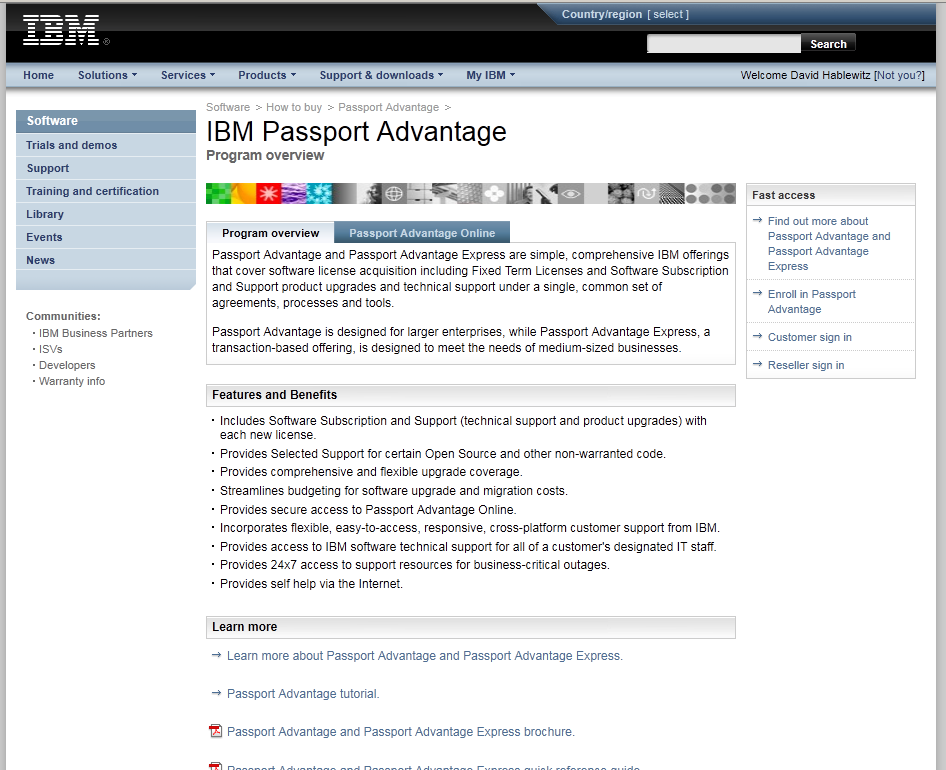
First, let’s find the URL. If I were to guess at it so I could go directly to it, I would expect something like http://www.ibm.com/passportadvantage . But that doesn’t work. So let’s go to the IBM home page, http://www.ibm.com and look for a link. You can find it on IBM’s home page, though with some effort. You won’t find it in any of the menus at the top of the page, but if you scroll down, you can find it “below the fold” under the Popular Links list. For that reason, I expect most people just use a search engine to find the site. I searched for “Passport Advantage” on Google.com and it came up as the first link. It was the second link listed on both yahoo.com and bing.com. It was also the first link in the results list when searched directly on the IBM website. Here is the landing page for all of these. The URL is http://www-01.ibm.com/software/howtobuy/passportadvantage/
<01_landingpage>
(click image to enlarge)
Not exactly an intuitive URL. Note in the screen shot that it already knows who I am. Am I logged in? Well, no. I need to click on the Customer sign in link in the box on the right labeled “Fast Access”.
Note that it instructs to use my email address for the user name. Not exactly. Some accounts (like mine) require the username that was created, NOT the email address.
<02_loginpage>

(click image to enlarge)
By the way, if I click on the link that says “Not you?” beside my name in the top right, I get this error page with no way back but to close the browser and start over:
<03_switchusererror>

(click image to enlarge)
After logging in, you get to what I will call the “homepage” of Passport Advantage. Actually there is no home page for Passport Advantage and there is never an obvious path back to this page. I could find no links that lead back to this page except by logging in. The Home link on this page goes to the home page of ibm.com and once you go there, good luck trying to get back to Passport Advantage. Assuming you know about the link at the bottom of the page, you’ll get back fairly easily. But most people just google it again. (even if you call customer support, they will direct you to find it this way!)
<04_homepage>

(click image to enlarge)
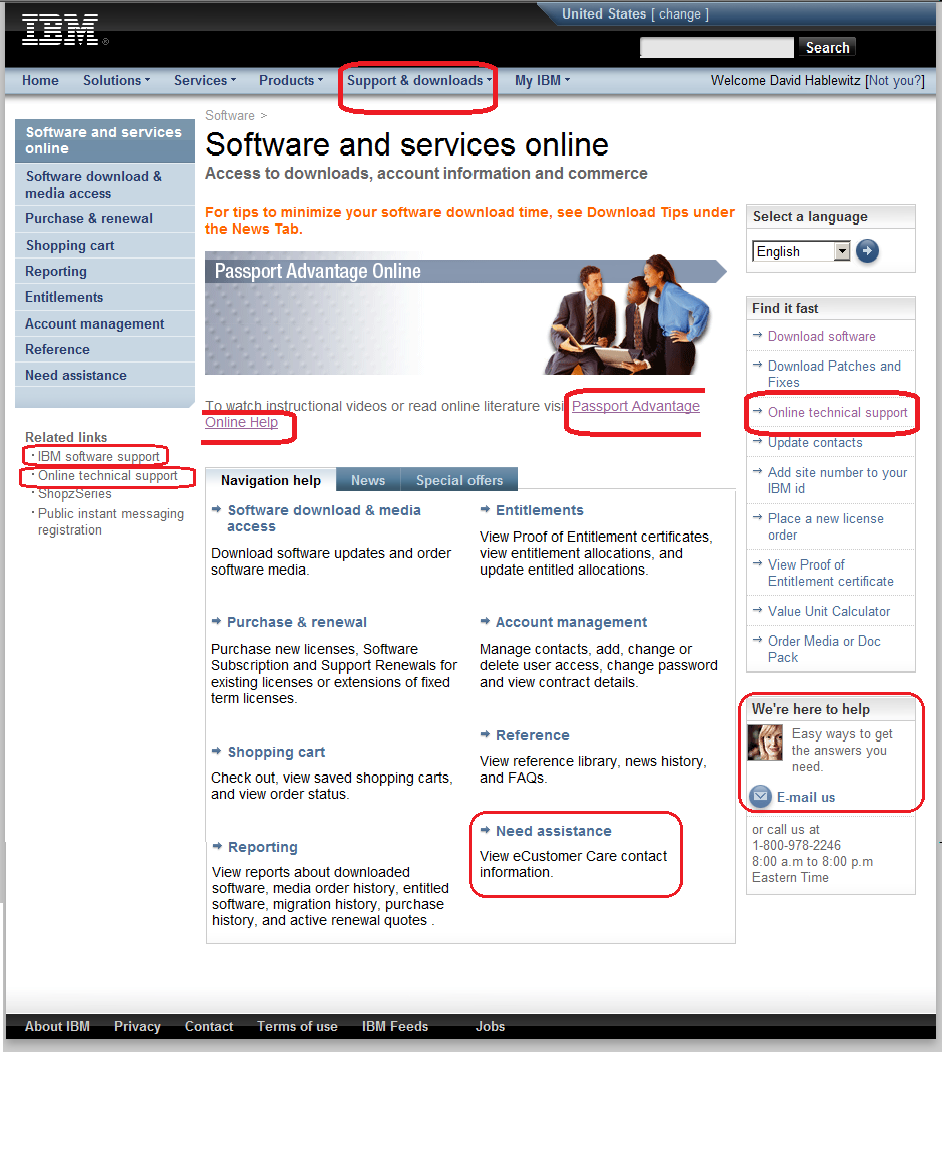
Great now you’re on the “homepage”. There are primarily 2 reasons most Lotus professionals visit this site: 1. To open a PMR with technical support or 2. To download software. Let’s start with getting technical support. Look closely. There are no less than 7 links to get some kind of help, not counting the phone number listed in the bottom right corner, which by the way, is NOT the number to call to reach technical support. Each of these 7 links go to different pages. The one to open a ticket with technical support (called a PMR) happens to be the last one in the left pane, labeled “Online technical support”. This would seem obvious but for the 6 other links to support on the page. By the way, if you visit a page and then hit the Back button, you will occasionally get an error instead and it will prompt you to log in again.
<05_supportLinks>
(click image to enlarge)
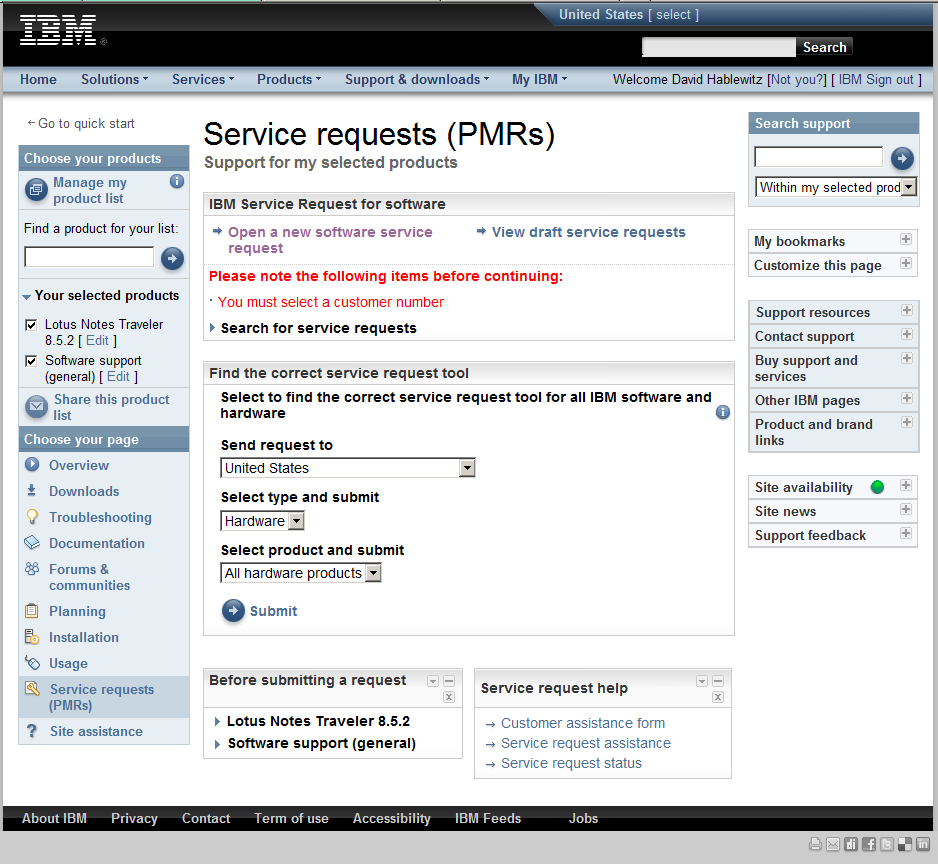
Once you get to the place to enter a PMR with technical support, you may want to get back to the “homepage”. Which link on this page do you think you should select?
<06_whereishome>

(click image to enlarge)
If you chose Home you would be wrong and once there you would not be able to use the back button to return here.
If you chose Return to the IBM Support Portal you would also be wrong. (See the next screen shot.)
The correct link is actually under related links. Go figure.
(click image to enlarge)
Now let’s look at the second common reason to visit this site: downloading software. For this function you “only” have 5 choices. Again, they all go to different places. Choose carefully. You may navigate through several lengthy steps before realizing you’re in the wrong place to find what you’re looking for.
<07_downloadLinks>

(click image to enlarge)
The downloads process continues through several confusing steps including prompting TWICE that you accept the software agreement, before actually getting to download the software. And you had better know exactly what you are looking for. There are no useful descriptions of the purpose of each software and many have very similar names.
In our classroom discussion the class agreed when it comes to usability, this site fails miserably, It is laden with many confusing links that are not organized in any obvious, meaningful grouping. There are way too many links without any form of structure or organization to the navigation. One of the class exercises is to create a site map identifying the navigation, but this website proved too complex to create a site map at all. The arrangement of the navigation did not help to identify the relevance of the links either. And why does it have 2 places to select a language? (one at the extreme top of the page, the other in the right column beside the banner image)
Well, there you have it. So far we have examined the pages leading up to the main page of the Passport Advantage site and the main page itself. What do you think? Is this analysis off the mark? If you regularly navigate this site, what has your experience been with it?
Up next if I have the time and patience: Stepping through the website to download software – no trivial task.
Before you pass final judgement on this website, check out what truly BAD websites look like at WebPagesThatSuck
Footnote: After writing this article, I noticed there is now a tutorial for Passport advantage on the landing page (you do not need to log in to view it.)
http://download.boulder.ibm.com/ibmdl/pub/software/passportadvantage/demos/English_Tutorial/english_pa.html
After a few minutes of frustration I had to quit viewing it. The wizard was tiny. The navigators to advance the slides are so small I had trouble getting my mouse in just the right spot to click it. There are pages and pages of blah, blah, blah. It isn’t a tutorial about USING the website. It’s about 45 minutes of reading all about WHY you should BUY it.
Brand as Mythology: Could the Lotus brand elevate to Mythology?
Here is an interesting perspective on branding, marketing, and the idea of a brand elevating to mythology.
http://sethgodin.typepad.com/seths_blog/2011/07/just-a-myth.html
How true is his statement: “People use a Dell. They are an Apple.”
I think Seth is touching on something that could be applied to the marketing of Lotus IBM software: “Isn’t that the dream of any marketer? To create a myth?”
As Lotus completes the long and painful process of being absorbed into IBM, could they, as Seth describes, invent a mythic brand with a story that promises to deliver an heroic outcome rather than just a product and a pile of facts. I believe it is possible. Ironically, by dropping the brand, it may elevate it to mythology. What do you think?
A split perspective on Quality. Does Quality really matter?
I came across this great article “Defining Quality” by Seth Godin discussing just what quality is and how it influences the success of a product. Seth describes the two types of quality: Quality in Design and Quality in Manufacturing. These two are as different as a brand new Bentley and a one-year-old Honda Civic. He also applies these concepts to the software industry.
What I find particularly interesting is his comment regarding these measures of quality:
“The balance, then, is to understand that marketers want both.
A short-sighted CFO might want neither. “
The issue that you may have experienced with corporate decisions about messaging software obviously carries over to just about everything else too. For those of us in the software industry who deal with CFOs who make seemly illogical decisions to switch software, (and make no mistake about it, it is the CFO more often than anyone else, who makes that decision) you are not alone. So if you find yourself trying to fend off the arguments for switching your messaging software, don’t think that they care whatsoever about which platform has more features or is easier to maintain or is more reliable. Before you try to make a case based on those points, you need to ask those most senior decision-makers just what really is important to them. Be careful of the mid-level managers filtering their responses too. They may be telling you what they think is important to senior management rather than what is truly important. If they really knew the pain points of the CFO, they would have already addressed them long ago. You can also read more about this factor in influencing decisions in the book “Neuromarketing: Understanding the Buy Buttons in Your Customer’s Brain” by Renvoise and Morin.
Regardless of your profession or position, you should arm yourself with an understanding of how those decision-makers make decisions and how they are influenced.
A sneak peek into the upcoming announcement about the Lotus brand and IBM’s 100-year philosophy
Is Lotus Notes the next Selectric Typewriter? This USAToday article about IBM turning 100 reveals some clues into the motivations that drive IBM which might tell us about their plans for the future.
“Don’t make the mistake of thinking IBM is a corporate old-timer that just watched technology evolve. It has remained at the forefront through the decades and tops several of its whippersnapper rivals in some regards. “
Of course we’re talking about the same company that totally missed some opportunities like the operating system for their personal computers that has gone on to become their nemesis. We’re talking about a company that has taken the once-famous brand of Lotus and made it disappear from the public eye better than a Harry Houdini magic act.
“This isn’t like the auto industry, where the combustible engine still exists, or oil, where many parts of the business are the same,” Iwata says. “We have to let go of what we have invented. We stopped making typewriters, punch-card machines, PCs. We had to move on.”
Hmm. Is this foreshadowing? When I was 8 years old I saw the movie “Old Yeller”. In spite of all the clues, I did not did not see that coming. I thought that dog would live forever. Have I gotten any better at reading the clues? Probably not. But here’s another one:
“•Ability to move into new businesses without abandoning core tenets. IBM is a classic example of a company that had to get into entirely new businesses, without turning its back on what got it to where it is, Collins says. If you consider what IBM’s mission is, it’s not about computers or technology. It’s about allowing its individual employees to create ways for its customers to solve operational problems, Collins says. Whether that’s a task best done with scales, typewriters or computers doesn’t matter; what matters is that customers’ needs are answered, Collins says. “
I don’t know how this movie will end. Maybe we’ll learn more on the Greenhouse webcast about the future of the Lotus brand June 28 at 10:00AM ET.
Meeanwhile, let’s get some popcorn and watch a few movie trailers.
IBM’s Watson makes person of the year
This should be a great boost to the IBM brand recognition:
(excerpt from Webby Awards )
The Webby Awards would like to honor Watson as the Webby Person of the Year in celebration of his groundbreaking scientific and technological achievements as the most comprehensive question-answering computer system. As the first computing system with an unparalleled handle and understanding of the natural language, Watson captivated millions as he competed on the game show, Jeopardy!, ultimately becoming the first non-human champion. It is undeniable that Watson has open the floodgates for advancement in all future computing systems, which is undoubtedly deserving of recognition and praise.
IBM is doing some great things in research these days. Check it out at the IBM research website.


 The Notes Guy in Seattle