Category Archives: Marketing
History of Innovations in HCL Notes & Domino (Lotus Notes) – PART 1: Security
Some people have forgotten just how much Lotus Notes changed the software industry and established innovations that were decades ahead of the rest of the world. Innovations that are being “reinvented” today in other software as if they were creating something new. Software developers think they’ve come up with some novel idea that was actually first developed by Ray Ozzie’s team years or decades ago. The new re-creations of these innovations often lack the refinement in one seamless environment like is found in the mature and 30+ years time-hardened software that is HCL Notes & Domino. This article is the first of a series that will explore a few of those landmark innovations that set Lotus Notes so far ahead of the competition and in many ways continues even today.
- Port 1352.
It’s a very special number among the Lotus Professionals. This is the port number reserved by the Internet Assigned Numbers Authority (IANA) that is dedicated to HCL Notes protocol, also referred to as the well-known ports. https://en.wikipedia.org/wiki/List_of_TCP_and_UDP_port_numbers
While many software applications may unofficially stake a claim on some particular port, Notes/Domino has had official, exclusive assignment of this port since the 1990’s. This makes it exceptionally easy to manage networks and firewalls while retaining security. - Multi-Factor Authentication.
Since R1.0 of Lotus Notes, it has had multi-factor authentication (MFA). What is all the rage today as an essential component of protecting your authentication and preventing unauthorized access, Notes has had from Day One. MFA requires two things: Something you have and Something you know. With Notes, these are the Notes user ID file and the password for it. Notes has provided this method of advanced security — natively and seamlessly — for over 30 years. Many of today’s web-based apps must go through all sorts of convoluted integration with systems to send text messages (vulnerable) or additional dedicated apps, like Authy or RSA Authenticator on your mobile device. Meanwhile, MFA in Notes is so seamless and has existed for so long that many people even forgot this is MFA. - Anti-spoofing protection during password input.
While we’re on the subject of passwords, Notes has another anti-spoofing feature that many people don’t think about. Have you ever noticed when you type your password into Notes, the dialog displays randomly from 1 to 4 ‘XXX’ characters in the password field? This is to obfuscate how long your password is, making it harder for an ‘over the shoulder’ attack. Also, there is a graphic that changes with every character typed. The graphic is displayed algorithmically, so at the end of typing your password correctly, it will always be the same graphic. If it isn’t, then either you typed it wrong or the screen may be a man-in-the-middle, posing as a Notes client. I have yet to see any other software provide these security features that have always been part of the Notes client.

- End-to-end encryption and compression during data transportation.
All communications server-to-server and server-to-client have the ability to be encrypted as well as compressed. This port level encryption prevents eavesdropping on the data being transmitted.
- NATIVE User-level encryption via public-private RSA key technology.
From the beginning, Notes has had a public and private key structure as an intrinsic part of the software that allows encrypting documents in Notes that can only be read by the intended user. This includes email messages sent within the mail system. The security was so strong, IBM was required to publish a separate, International version of the software that the U.S. government could decrypt.
Unlike other platforms out there which have finally come around to recognizing the value of this functionality, require third-party add-ons and complex administration, this feature has long been an integral innovation used in Notes out of the box. Read more of that history here.
- Encryption of data at rest.
Notes and Domino are also able to use the encryption key infrastructure in Notes to encrypt database files stored on the disk drive. This secures data from someone attempting to access the file directly from the operating system outside of Notes. This is especially effective in securing data on laptops, for example. Just another innovation that has been an intrinsic part of the software for decades.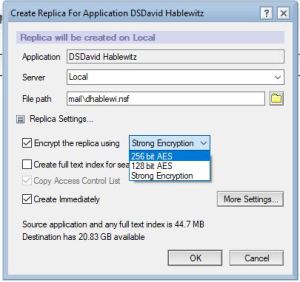
- Cross Certification with other organizations.
Notes has built-in the ability to ensure the identity of external organizations through the cross certificate process. Both organizations share a public key to each other that can then be used to verify the identity of any connection from that external user is truly that user and prevents someone from creating a bogus identity to masquerade as them. What is a trivial procedure using a Notes “smart client” in the Notes/Domino platform, is is a painfully complicated process for platforms that use “dumb clients” (web browsers). How long has Notes had this? Right. Since the 1990’s.
- Execution Control List (ECL).
You know how Windows will prompt you to ask if you trust an application to make changes to your computer? Well Notes has had that as an integral part of the software long before Windows did it.
Here is an example of what you see in Windows (UAC):
Notes has similar settings, only far more granular. Here is one alert specifying a single type of action by a single signer: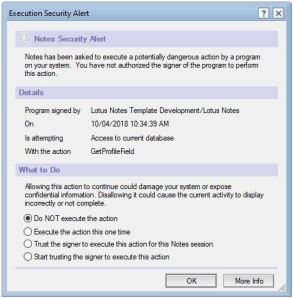
This dialog allows setting the default values for all the possible execution actions in the ECL settings:
- Ability to view file attachments without the risk of running potentially harmful code.
When you receive an attachment in email containing malicious code in it, if you were to open it in its native application, it may cause harm to your computer. To prevent this, Notes has an option to View the attachment via a simple, built-in viewer which can’t execute any code. The result is a fast, simple, safe way to see attachment contents.
On this great feature, I think they made a regression in V10. Prior to V10, if the attachment is an executable program (.exe for example), then the viewer would just display the compiler information — very handy for quickly identifying if it was created by the source you were expecting. As of V10 this feature was modified so that the “dumb” viewers were removed and it now uses a web browser instead. This process is a bit slower to open and it launches your default web browser which you may not want to open. For that matter, it requires that you have a web browser installed. I don’t know what the risks to malware are for attachments opened this way. I personally prefer the original solution. In any case, this feature is another example of the innovations that have been in Notes well ahead of the competition.
Here is what it displayed with an executable: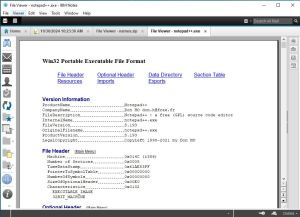
This is what it displayed if you clicked View for a .zip file: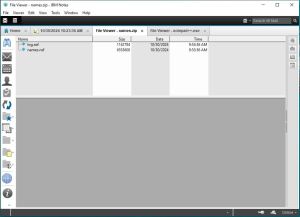
(If you would like to see this feature restored to its original implementation, please vote for the idea here:
https://domino-ideas.hcltechsw.com/ideas/NTS-I-2705
In summary, this is just a sample list to highlight of some of the innovations that Notes has had over the years in the area of Security that set it apart and ahead in the software industry.
Coming up: Innovative user features that set Lotus Notes / HCL Notes apart
Notes.net domain: Holy Grail of the Notes Community Sits Silently Waiting
Home/Notes/net: Every Notes client has a connection to this Domino server with DNS name home.notes.net.

The founding fathers of Lotus Notes demonstrated their Public Relations vision and genius when they defined a connection to this server in every HCL (Lotus) Notes client software installed. (They stopped short by not including icons to notes.net databases on installation.) The public relations and brand-building opportunities here are incredible, quietly waiting to be tapped. It begs the questions:
Why aren’t we using this today? What happened to the Home/Notes/net Domino server?
With such a resource built into the software, HCL has the potential to directly reach every single Notes user in the world. How powerful could that be? What price would a company pay for such ubiquitous reach into their customer base?
What did the original creators of Lotus Notes have in mind when they created this server that would have a direct touch to every single user of their software? I haven’t been able to find the answer yet, (if you know, please post in the comments), but I can think of many ways this could add to the value of the software and the bottom line of HCL’s stock. Here are a few examples:
– Help databases
– Tutorial videos
– Periodic news letter
– Tips & tricks for end users, admins, and developers
– A Notes application store with live examples
– A sandbox for “trying before buying”
– Demonstrate the power of Notes clients over web browsers
– Community discussion forums
– Hosting for Notes user groups
– A working Sametime environment for people to connect, chat, and build a community
Just imagine, a public Domino server (cluster) demonstrating the full power of Notes and Domino. This is but a small sample of the incredible ways notes.net could be leveraged. What would you like to see hosted on the home.notes.net server? Please share your ideas in the comments below. Also, Please support this idea and vote for it here: https://domino-ideas.hcltechsw.com/ideas/NTS-I-2669
Everyone who uses Notes should know about Home/Notes/Net.
Ask HCL Anything Session at HCL Factory Tour Sept 2022
As a reminder that I’m not here to ask the easy questions. I am here to ask the tough questions. I consider myself as much an ambassador of the customers and business partners as an ambassador of HCL. Thank you HCL for the transparency to allow me to moderate this session.
0:00 Introductions
2:52 Question #1: Will you skip V13?
8:34 Question #2: Can you give us Greenhouse again?
12:42 Question #3: Give us material to share your vision
16:07 Question #4: HCL Ambassadors deserve recognition
20:20 Question #5: Mac Notes client chronic problems
26:55 Question #6: How will you attract the next gen developers?
31:47 Question #7: What features do you wish would get more use?
37:36 Question #8: Where’s the app store?
39:52 Question #9: Adoption will not come from developers
44:58 Closing
Question 1 from David Hablewitz: Will you skip version number 13?
Meant to be a humorous question making light of superstitions, this went down a path I wasn’t expecting.
Question 2 from David Hablewitz: The community formerly known as Lotus has become fragmented and scattered, gathering online in many disconnected and hard-to-find places where we communicate, share knowledge, find resources, try out software, etc. For instance, there are groups on Skype, Slack, Discord, Facebook, and LinkedIn. There is the HCL support forum; there is a sandbox for Nomad web; there is a community for trying out and discussing the early release of Notes / Domino 12.0.2; OpenNTF; the HCL Academy and youtube channel; the HCL blogs; the software documentation website, not to mention an entirely separate website for downloading software. All of these are fragmented and difficult to find. Furthermore, HCL has is no community at all to bring business partners together or to support them. Why don’t you have this all in one place and use the products themselves to host it as a proving ground of its capabilities?
Response: To summarize, the answer wasn’t clear, but I think with more discussion and clarification of what I am looking for from HCL, we could get somewhere. I will pursue this further.
Question 3 from John Shultz, Prominic (off camera): How do you empower us to leave this event with tactical and tangible information to share with my team? Something I can share with people in my support and marketing teams so they can share your vision?
Response from Francois Naser, Go to Market Leader: You will be receiving an invitation to training for business partners within the next 3 weeks. 3 sessions: 1. Domino & Sametime; 2. Volt MX; 3. MX Go (I can confirm this happened. Video recordings are available.) This will also be presented in person at the Milan Factory Tour.
Question 4 from David Hablewitz: When are you going to start recognizing the HCL Ambassadors for the value they bring to the community with HCL Ambassador branded gear?
(Note: until I asked this question, the HCL Ambassadors had not been mentioned or recognized at all for the entire 3 days at the Factory Tour.)
Background: When IBM was involved, IBM Champions were given items such as a plaque to put on the wall recognizing their service, jackets, shirts, and other items with IBM Champion logos. At conferences like this Factory Tour They would get special lanyards for their name tags that clearly identified them as IBM Champions. HCL has had the Ambassador program for 4 years now without giving any recognition to these individuals. One of the dinners at the Factory Tour We were served Maine lobster. Surely if HCL truly valued the dedication of these people, they could find funds to support the program.
Response from Maria Nordin (off camera) “We might have a solution, but I do not want to promise anything because I know how that feels. Maybe in 2 or 3 months, we may have something. I am working on it very, very hard.” Richard Jefts added “we were able to get for T-shirts for the HCL staff at this event, so there may be something they can do.
In addition, Richard Jefts went on to say regarding marketing [paraphrasing] “Meanwhile, HCL Tech has signed on as one of the sponsors for the Metlife Stadium where the New York Jets and New York Giants football teams play. HCL Software plans to follow suit with branding on F1 racing and European Cricket and sponsorship for the World Cup in Qatar. There are discussions about having Domino branding in geo-specific airports in places like Frankfurt and Tokyo.”
While the brand awareness somewhat matters, I applaud the efforts to advertise the Domino product. IBM was infamous for making the mistake of building brand awareness and ignoring promoting products. Without product marketing, brand marketing is a waste.
In any case, if you can spend hundreds of thousands to put your name on a stadium or an F1 car, it only makes sense to invest in the most dedicated people who unselfishly support and promote your business. Research has proven a loyal fan base is an essential component of product success.
Question 5 from Bill Malchisky: [paraphrasing] While we appreciate all the new products and features, where is your commitment to making the existing Notes client software stable, in particular the latest problems with the Mac Notes client?
Response from Andrew Davis: Apple has introduced regression bugs and we’re working with them to resolve. Meanwhile, please create a support ticket so we can work to resolve them.
Response from John Paganetti of Client Advocacy group: You can also reach out to your client advocate if you have more.
In addition, if you are not already in the Client Advocacy Program, contact Deronza Sanders or John Immerman, or John Paganetti. Every customer should have a contact in this program.
Question 6 from Bob Ascott: Who will be filling in for the next generation of developers in this software?
Response from Luis Guirigay (off camera): The HCL Academy will be releasing 80 to 120 hours of education for new software developers. They will be releasing similar education program for administrators. Along with this are certification tests coming out soon which will further legitimize it.
Response from Jason Gary: This is why the development in the product to translate code
Response from Michael Alexander: We are also working on producing documentation and other assets and why they are embracing languages like Javascript.
Question 7 from Carl Tyler: What features of the product do you wish were more widely understood and used by customers?
Response from Andrew Davis: Domino Domain Monitoring
Response from John Paganetti: ID Vault and Transaction logging
Response from (person off camera): Notes Stream and the stream class, a feature under used by developers
Response from Richard Jefts: Leap is not being used widely to build NEW apps. Also, Nomad is under-used.
Question 8 from David Hablewitz: Platforms are only as good as the ecosystem they support. When are we going to get an app store and make it accessible directly from within the Notes client?
Response from Andrew Manby: HCL is working on their next generation of SOFI. Their intent is to move it to become their full marketplace to have one location to handle apps for all products: DX, MX, Domino, They are working on it, though it is taking longer to develop than they expected.
Thomas Hampel: We have an internal prototype already running and it is already on the roadmap.
This is an awesome response!
Question/Comment 9 from Jamie Magee: Developers won’t be the ones picking and choosing to use Domino. It will be assigned to them. The marketing will determine the adoption by business owners which will lead to developers building apps in it.
Richard Jefts: We don’t have a true CSM (customer success manager). We call our inside sellers who handle renewals CSMs, but they are not CSMs. The only product we have a true CSM organization for is Volt MX. There should be a team at HCL ready so when a customer buys, for example, HCL Volt (Leap?), we have someone who will engage the customer and help them build their first apps. This where I see we have a gap. We still have that IBM mentality where after the sale, the next time they hear from us is when it is time to renew their software licenses. KK (VP at HCL) has just become aware of this gap and is onboard with creating this resource.
Final comment from David Hablewitz: My tap water comes from the Cascade mountains in Washington state where I get 100 cubic feet of water for $3.24. A local bottled water company takes that same water, packages it into bottles, and resells it for $15,000. What is the difference between my $3.24 of tap water and the bottled water that makes it worth $15,000? Marketing. THAT is the value of marketing.
Domino Mobile Apps for the iPad is Here!
A Notes client (sort of) for the iPad has just been released! This is the announcement. I’m looking forward to the next steps when they port this to the iPhone and Android phone. All the security, replication, workflow and offline functionality of Notes with the portability of a mobile device and no redundant develop to web-enable any apps. Nice job IBM and HCL.


|
The Unsung Hero.
It’s always been there, quietly doing what it does oh so well. So good that you probably forgot it’s there. The unsung hero. Watch…
Is your company small? medium? large? Grande? Domino does it. Learn more at https://www.ibm.com/destinationdomino
The marketing might have taken a 2 decade break, but the software never did.
Learn About IBM Notes & Domino 10
Divergent Solutions is now a certified IBM Notes & Domino 10 Sales Advisor which is fancy-talk that means you can contact me to learn…

WHAT… the new features are in Notes and Domino 10 and the new partnerships
HOW… to take advantage of the new software and partnerships
WHY… these features and partnerships are going to radically change your company’s application development strategy
What do Apple, Twitter and Facebook all have in common?




IBM is doing some interesting things to blur the line between consumer and business computing and the pace they are moving at has accelerated like a Mad Max roadster on nitro. In the past year they have joined forces with Twitter, Facebook, and most notably, Apple. The partnerships all bring together complimentary products and services. The venture with Apple, in particular, is worth paying attention to. Apple has virtually no formal enterprise solutions, yet they still dominate the business world with mobile devices. IBM on the other hand, has MobileFirst, their set of mobile solutions for business. Meanwhile, IBM has no mobile or desktop hardware and OS, so it must rely on other vendors to provide that foundation. Combining the solutions from Apple and IBM makes for a compelling case against against Microsoft and Google. The one partnership that seems to be missing is LinkedIn.
Add to these partnerships with consumer-focused companies, IBM is doing some consumer focus of its own. They have just released IBM Verse, a new online email application intended to compete with the likes of Hotmail and Gmail, at least to get consumer adoption, with the intentions that it will become the first choice for business too. While Verse is in the early stages, a steady stream of features are being added on a weekly or monthly basis.
All of these signs lead me to believe that after all these years of analysts and business partners urging and pleading, IBM finally recognizes that it needs to win the consumer first in order to win the business.
They have stepped up their marketing efforts at the same time, which is a treat for business partners. Who knew that for several years now IBM has posted the largest revenue of cloud services? (even over Amazon Web Services)
Yes, they still have work to do in marketing their web services. Often I give demonstrations of IBM Connections Cloud, an ecosystem of software services comparable to Microsoft Office 365 and Google Apps for Work, and I always get several people in the group asking “Why are they keeping this a secret?”
One final step IBM is taking is in making their solutions more attractive to small business, not just enterprise-scale organizations. Their solutions make a powerful case for businesses of all sizes now. I think the next year is going to be game-changing for IBM. The surveys from 3 years ago are actually proving out. IBM is proving why it was named one of the Four Horsemen of technology companies.
IBM partners with Twitter
IBM partners with Facebook
IBM expands partnership with Apple
IBM’s next generation cloud email solution is coming to CONSUMERS for FREE!
Last week IBM provided a glimpse into their next innovation in email. Code-named MailNext, it is now formally named Verse. This is the next evolution of Connections Cloud, their enterprise cloud suite of software.
Now, just a week later, IBM has announced plans to make Verse available to CONSUMERS for FREE!!!
This is unprecedented by IBM. First, this is the first time IBM has targeted consumers rather than businesses. Second, the price is right to attract users to experience the new concept in messaging. Free. A brilliant strategy to finally take an aggressive action toward marketing their product by first winning over their market as individuals and then as businesses.
Long ago Microsoft did this by including Outlook with every operating system. Consumers used that interface to use POP to access their personal email accounts. Familiarity at the consumer level made it easy for businesses to be persuaded to use it along with Exchange server for an enterprise messaging system. Then Google repeated this successful recipe to build a strong consumer base before diving into the enterprise messaging marketplace.
Now IBM is going to apply the same formula. Unlike Google however, IBM is not going to turn consumers directly into profit like Google does with their advertising and scanning of email. They will be targeting Businesses to provide the revenue.
The beauty of this formula is simple. Email is the software equivalent of a Gateway drug into the collaboration software market. And IBM intends to get you addicted to theirs. In this case, those hardcore drugs are IBM’s collaboration software suite: Connections (team, B2B and B2C tools for file sharing, activities, wikis, blogs, forums, surveys, & more); Sametime Instant Messaging, video, audio, web conferencing, and Notes & Domino. And IBM is taking the same approach as the State of Washington, making their gateway drug very accessible and affordable to everyone.
I have to wonder if this isn’t at least partially driven by IBM’s new partnership with Apple who has proven how successful consumer loyalty can be. Many of us who work with the IBM technology and understand how much more powerful it is than the competitive products have long blasted IBM for shunning the consumer market. I have often thought one of their biggest mistakes was separating the application designer tools from the Lotus Notes client which took away the power for end users to apply their own energy to create the custom applications they needed. At that point in time they disarmed their greatest allies and advocates of the software. It looks like the giant has finally awoken and recognizes the power that the individual has on the choice of software in the workplace. I am anxious to see what this new evolution will do for improving our productivity in the most widely used software category in the world. How do you think this will impact the landscape of the collaboration software market? Want to see for yourself? Pre-register here.
Passport Advantage Revisited 2 years later…
In August 2011 I posted an article giving a detailed analysis of the design of the IBM Passport Advantage website. That article received a great deal of attention, not only from the Lotus user community, but also from executives at IBM. I was even contacted by the person who oversaw the team responsible for the site. Finally, I thought, we would see some relief in our pain dealing with this website.
It’s nearly 2 years later. There have been some changes to the IBM websites, but Passport Advantage has had no significant changes. I’m here at IBM Connect 2013 to once again ask the question “When will you fix this website?” If you’re here, watch for it at “Ask the Product Managers” session. I will report the results later.


 The Notes Guy in Seattle