IBM announces MobileFirst and partnership with AT&T
News sources are reporting the new announcement of IBM MobileFirst solutions portfolio. This is big because, unlike other players in this market, IBM is the leader in remaining device agnostic in the BYOD (bring your own device) business world. Mobile technology is blurring the lines between consumer and business tools. There is no doubt in my mind as I watch my 13-year-old daughter do 90% of her computer-related activities on her smartphone that this is the destiny of technology. It is promising to see IBM extending their mobile architecture further. They are already experts at cloud services, analytics, social business, and application development. It only makes sense they would be expanding their mobile initiative to meet the needs of business.
As they are partnered with AT&T, this news is very relevant to the Seattle area which is home to much of the AT&T Wireless services (Redmond and Bothell).
For more news on this, visit:
NY Times
Get more news about it at the blog of the person leading this initiative, Ed Brill.
Doing well or not, it’s all about attitude.
I first posted this in my status on Facebook. But the comments that followed my post made me realize this is relevant to a broader audience, so I will share it again here.
These people on the Carnival cruise adrift in the Gulf of Mexico are complaining because they have no air conditioning, no lights, no flushing toilets, limited hot and cold food, stuck in close quarters with a bunch of people they don’t know. Some are sleeping in tents outside because it’s so hot. Funny. We had the same conditions rafting the Grand Canyon and we all thought it was fantastic!
Interesting how the way you frame the situation can make all the difference between loving it and hating it. It’s all about perspective, isn’t it? Reminds me of this story…
Share your thoughts.
Passport Advantage Revisited 2 years later…
In August 2011 I posted an article giving a detailed analysis of the design of the IBM Passport Advantage website. That article received a great deal of attention, not only from the Lotus user community, but also from executives at IBM. I was even contacted by the person who oversaw the team responsible for the site. Finally, I thought, we would see some relief in our pain dealing with this website.
It’s nearly 2 years later. There have been some changes to the IBM websites, but Passport Advantage has had no significant changes. I’m here at IBM Connect 2013 to once again ask the question “When will you fix this website?” If you’re here, watch for it at “Ask the Product Managers” session. I will report the results later.
Preparing for IBM Connect 2013 (Lotusphere) and another “Outlook can’t do that” moment
As I review my flight itinerary, I’m looking forward to the Alaska Air non-stop from Seattle to Orlando, fondly known as…The Disney Flight. No lie. See the photo.

This time there will be no missing B.A.L.D. due to missed connections, flight cancellations or delays because of a storm blanketing the center of the country. Wuhoo!
As I added my IBM Connect (Lotusphere) Conference travel plans to my IBM Lotus Notes calendar, Alaska Airlines graciously pointed out on their website yet another limitation of Outlook. They have a handy “Add to Calendar” feature. When you click it, it gives the option to add each flight to the calendar as a separate entry with the stipulation: “(not compatible with Outlook)”. See below. Just more proof that popularity does not equate to quality. In a way, I’m thankful. If everyone used IBM Lotus Notes, that would be one less advantage my clients had over their competition.
See Y’all in Orlando! If you’re going, tweet me @davehabz and let me know so we can meet up!

Click Add to Calendar
- Click Add to Calendar
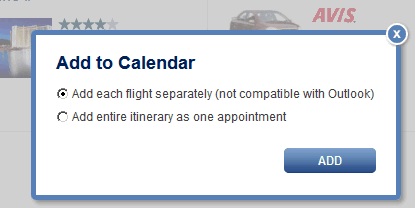
Too bad Outlook users…

But if you use IBM Lotus Notes…
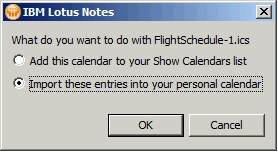
Import the entries so they are available when offline.

Voila’, individual entries for each flight.
_____________________________________________________________
The Single biggest cause of Lotus Notes client crashes and how to avoid them
(For a related article, see my post titled Quick Tip: Fix for unexplainable common crashes of Lotus Notes 8.x with Eclipse )
While reviewing an environment with about 3000 users, I discovered an extremely high number of fault reports occurring. On a daily basis there were from 100 to 200 faults reported. Some users were crashing every single day. Clearly this points to a systemic problem, probably due to some software conflict or other configuration issue widely used within this organization. Yet for all these crashes, the users were not reporting any problems. While they weren’t reporting problems, this was likely to lead to bigger problems from file corruption if it wasn’t already. I needed to find the cause. One catch though: I had limited access to the computers or contact with the users. This can make troubleshooting very difficult.
The first step was to examine the data submitted in the Fault Reports database. Unfortunately, the crashes were not reporting much, if any, useful data, including only partial .NSD files. Fewer than 10% of the crashes even reported a version, but of those that did, they were all either Release 8.5.2 or 8.5.3 with various Fix Packs. While we were only about half way through an upgrade from 7.0.x to 8.5.3, none of the crashes reported a version of 7.x. If all the crashes are 8.5.x, then that makes the fault rate even worse; about 10% per day for fifteen hundred 8.5.x users! Yet no one was reporting any problems. Quite the mystery.
The next logical step would be to run Fault Analyzer against the Fault Reports database to look for trends in the fault reports and to examine whatever is available in the .NSD files for any clues. The .NSD files were mostly empty and Fault Analyzer proved useless because there wasn’t enough data reported in the fault reports. For those crashes that did report some data, examining them manually, I found a common thread among some of the crashes:
Host Name : LAPTOP1234
User Name : SYSTEM
Date : Thu Oct 11 10:33:24 2012
Windows Dir : C:\Windows
Arguments : “C:\Program Files (x86)\IBM\Lotus\Notes\nsd.exe” -dumpandkill -termstatus 1 -dlgopts showwait -wctpid 5292 -wctexitcode 1073807364 -panicdirect -crashpid 3940 -crashtid 516 -runtime 300 -ini “C:\Program Files (x86)\IBM\Lotus\Notes\notes.ini” -svcreq 128
NSD Version : 8.5.23.1132 (Release 8.5.2FP3)
OS Version : Windows/7 6.1 [64-bit] (Build 7601), PlatID=2, Service Pack 1 (8 Processors)
Running as 32-bit Windows application on 64-bit Windows
Build time : Mon Jul 11 03:15:18 2011
Latest file mod : Fri May 13 09:03:31 2011
Notes Version : (32-bit client)
ERROR (79): the directory () does not exist – (22) Invalid argument
ERROR (44): unable to open file ‘C:\Program Files (x86)\IBM\Lotus\Notes\Data\formats.ini’ – (2) No such file or directory
This is an odd error, but searching the web I did find others who reported a similar problem and they solved it by getting a copy of the formats.ini file from a good installation and adding it to their computer. Could it be that our customized installation kit was missing this file? If so, it would be a straightforward fix, though it would have to be applied to all computers already upgraded. However, an inspection of one of the computers that had been crashing revealed the file is right where it should be. This was a dead end.
Finally I was able to work with one user on the issue. She had been crashing several times a week for the past few months though she never noticed. The crash reports were time stamped fairly consistently at around 7:30 AM correlating with the time she came in to work. The user did not report any unusual behavior when she started her computer, though occasionally Lotus Notes did “take a long time to start”. So one morning I watched her go through her morning routine of starting up and logging in. There was nothing unusual. No crash report posted either. Time to do more trend analysis.
I created several views in the Fault Reports database trying to identify any other trends using different categorized sorts: by date, by user, by hour of the day. When categorized by the hour of day, the crashes revealed a trend. The majority of crashes were in the afternoon between 1:00 PM and 5:00 PM (hours 13 – 16).

Fault Reports by Hour of Day
I sorted this view further by user. From this I noticed that, while the crashes were scattered throughout the afternoon, for any given person they were usually crashing in the same hour almost every time. I re-sorted the view so it was first categorized by user and then by hour and added a column with the exact time of crash. Now I could see all the crashes for one person grouped together and categorized by hour. Then scanning through the users with very high crash counts, I found the final clue: One user crashed at precisely 5:00 PM every single day. This user was crashing at precisely 5:00 PM every day and the crashes were being submitted consistently at 8:02 AM the next day.

Crashes occurring at 5:00 PM daily
This person happened to be the receptionist. Her work hours are precisely from 8 to 5. Looking more closely at the other users I could see the crashes were typically occurring about 8 hours after the previous crash report was submitted by each person. It is important to note here that the crash report is reported (Creation date/time) at the next restart of Notes. In other words, Notes would crash at the end of their day and they didn’t restart Notes until the next morning.
I called the receptionist and asked how she shuts down her computer at the end of the day. I expected to hear her say she just hits the power button, but that was not the case. It turns out she clicks the X in the top right corner of Notes to close the window, then clicks Log Off on the Start menu immediately after. Apparently Notes 8.5.x takes longer to close than 7.x and it was not able to close before the OS dumped it from memory during shutdown, thus causing it to not close cleanly.
With a bit of user training, this problem has been resolved. They were told to give Notes an extra minute to shut down before logging out or just lock or hibernate the computer instead of logging off.
I think this is a flaw in the interaction between the OS and Notes, but until that is fixed, this is a clean, simple work-around. What are your ideas and experiences with this?
Bothell, WA Mayor Mark Lamb in Sex Scandal Mirrors General Petraeus in Washington DC
What does Bothell, Washington and Washington DC have in common? How about a sex scandal involving leaders that finally revealed their true lack of integrity and demonstrated why they can’t be trusted that they will serve the best interests of the people. Within a week of General Petraeus resigning after his extramarital affair was exposed, the improprieties of our mayor Mark Lamb here in Bothell, WA have been similarly revealed.
In the past, there have been questions about Lamb’s motives in how he influenced city activity from which he or certain developers may have benefitted. But when he demonstrated that he would discard the sanctity and oath of his marriage for the sake of his own personal gratification, Mayor Mark Lamb threw his moral integrity right under the bus. So why would our community have any reason to believe that Mr. Lamb would be any more faithful in upholding his oath to protect the best interests of the City of Bothell over his own personal gain when he wouldn’t even uphold his oath to his own wife?
I expect this latest incident will eliminate any chance of his re-election. I hope Mr. Lamb will accept the fact that the public has lost all confidence in his ability to serve as mayor of Bothell and will resign his post promptly. You can read more about this story at http://www.bothell-reporter.com/news/179152821.html
Overview of Windows 8 Unleashed Event held in Seattle
If you do development in Visual Studio or even JavaScript, you should check out what is coming for developing in Windows 8. I was impressed with what I saw at the Windows 8 Unleashed event held at Microsoft in Seattle. They highlighted a few key new features available for developing apps to run in Windows 8. The things that jumped out were the ubiquitous nature of apps now. Content and states of applications can follow you as you go from machine to machine. So if you play a game on your phone and then go to your laptop, you score will follow you. I’m not talking about a website, I’m talking about a local app. This data sharing occurs via your Windows Live account or Skydrive.
They showed how to manage the dynamic icons on the new desktop and how apps can receive updated information even when not running.
If you plan to monetize your apps, the store model has changed dramatically. Microsoft is predicting 400 million new computers will be purchased in the next year and 65% will use windows OS. That equates to 260 million computers. This will create a huge market for apps. Microsoft intends to take advantage of this opportunity by working hard to promote the apps and to extend the advertising done via apps. A handy little promotional feature is that you can share an app with your friends. That works similar to sharing apps on facebook.
Microsoft wants your apps to sell because they are going to take 30% of your revenue up to the first $25,000 in sales, then 20% of all sales above that.
Those are just a few highlights. They presented much more information than I covered and had labs to test it out, but rather than repeat it all here, I will guide you to visit their website where you can find all of the resources that they used in the workshop.
One of the best things I got from the resources were the links to setup a VM and a demo version of Windows 8 to play with.
There will be a few more events held around the country
that you might have a chance to attend. Most likely you won’t be able to attend one live, but much of the information is available online.
Save Our Farms and Wine Country in King County, WA
This is an open letter to King County Council and the City of Woodinville with regard to their plan to open up the Sammamish River corridor to urban development:
Dear King County Council:
I live a mile from downtown Woodinville, WA. Before living here, I lived on 3 acres in a semi-rural part of South Carolina. When I first moved to Puget Sound 12 years ago, I was immediately drawn to this spot because of the country feeling it has, yet is so close to everything in the city. My commute to work has consisted of riding the 1 mile down to the Sammamish River bike trail, then 10 miles on a quiet, scenic ride along the trail to Marymoor Park, then 1 more mile up to my office. Even in the winter, this is a pleasant ride.
On my ride in the mornings, the air smells clean and fresh. There are no roads or houses anywhere close to the trail. I see lots of wildlife: rabbits, beavers and herons are always there. But the wilderness experience goes far beyond that. I have seen a coyote catching a rabbit. I have seen an eagle catch a duck in the middle of one of the farms; I have had an owl fly along beside me as I rode home in the winter night. This place is surprisingly quiet and devoid of noise pollution. A great comfort for people and an absolute necessity for creatures like owls which depend on hearing to catch their food. This corridor is a great sanctuary for people as well as wildlife from the growth and expansion of urban life and an important reason why I choose to live here.
At night, this corridor is one of the few places not flooded with light pollution, yet open enough to see the sky. I sometimes take my daughter here to see the stars. Earlier this year we were able to go down to the bike trail near the St. Michelle winery to watch the meteor shower and another time to watch the lunar eclipse. During the day, this is one of the few places near my home where I can get an unobstructed view of Mt Rainier. Most evenings throughout the summer, a pair of hot air balloons can be seen drifting down the valley where they will land in a field. These balloons are as much the trademark of the City of Woodinville as the Space Needle is of the City of Seattle. (see the city logo in the top right corner of the City of Woodinville website)These experiences will all be gone permanently, when you open this area up to development.
I support protecting our farms, forests, and rural lands. These lands are important, not only to Woodinville’s wine and tourism industry, but to everyone who lives here or passes through. Many thousands of cyclists use this corridor daily. To quote from your own website:
“The Sammamish River Trail (SRT) runs 10.9 miles along the Sammamish River from Bothell to Marymoor Park in Redmond as part of the “Locks to Lakes Corridor.” The SRT is paved its entire length and is one of King County’s most popular regional trails. The trail offers extraordinary views of the river, the broad Sammamish River Valley, Cascade foothills and Mt. Rainier. Bicyclists, joggers, skaters, walkers, and others enjoy the trail as a regional recreation resource. The SRT is also used extensively by commuters as a nonmotorized corridor between suburban cities and Seattle.”
To develop this land will not only diminish the value of the valley itself, but also destroy the very reason many people are drawn to this area to begin with. Please protect our lands by keeping King County’s designated urban growth area right where it is.
Sincerely,
David Hablewitz
If you support this letter, even if you don’t live here, please add your name below by simply posting a comment. You can write your own letter by visiting http://www.savewoodinvillefarms.org
Please respond quickly. Hearings are to be held on this topic September 11, 12, and 18
SmartCloud leads IBM to dethrone Microsoft on CNN’s “Four Horsemen of Tech” list
The times, they are a’changin’! In the shifting sands of technology, IBM is proving to be the Rock of Gibraltar.
CNN Money just conducted their annual survey of technology and investment experts to determine which 4 technology companies are the best investments in the industry. Apple, Amazon, Google, and IBM are what they describe as “The Four Horsemen of Tech”.
Microsoft and Dell are no longer on that list. And as recently as 2 years ago Research in Motion might have been expected on that list. The CNN article describes the changing of the guard is due to the shift from PCs to mobile and cloud solutions. I think it goes deeper than that.
Apple, Amazon, and Google are all following the same track that led Microsoft to its fame and glory days by riding the fast-but-fickle success opportunities provided by the consumer market. They are simply the latest fashion trends. In this list of top performers, IBM is the dark horse, being the only one not involved in consumer products whatsoever. They also just celebrated their 101st birthday this year. Coincidence? I don’t think so.
Rides on the consumer wave are relatively short. Google is 16 years old, Amazon is 18 and Apple is 36, though Apple’s great surge came in the last 6 years starting with the introduction of iOS. For reference, RIM and Dell are 28 years old and Microsoft is 37 and they are already declining. They too, based their success heavily on consumer products and are now feeling the consequences. Yes, RIM’s BlackBerry is intended to be a business tool, but it is a consumer device first and foremost. It is considered even more personal than a personal computer (PC). One might argue that Microsoft also makes software for business, but their primary focus has always been on consumers and their foray into the business product market has depended on consumer-driven brand recognition. Also, because many of their products service both business and consumer needs, they are driven by consumer markets. (See RIM.)
Similarly, the focus that led 3 of the current Four Horsemen to their place in the lineup has a consumer emphasis: mobile devices and advertising. Apple’s iPhone and iPad redefined mobile. Google has Android devices and search (advertising). Amazon is into selling (and advertising) along with the Kindle for a mobile presence. All of them are also dabbling in cloud services for businesses. Then there is IBM, the seasoned veteran of business solutions. What makes them part of this leadership crowd? I isn’t just for their SmartCloud solution, I think it is the fact that they have stayed true to their earliest beginnings. Unlike all of the other players, IBM has focused their attention, with laser beam precision, on the proven stable base of the business market.: They provide business solutions for businesses. IBM has resisted the temptation to cross the line into the consumer market, even at the urging of experts and loyal customers who pushed to have Lotus Notes repackaged for consumers. Doing so in the short term would certainly win consumer approval and thus fend off the consumer-led push for the Microsoft Outlook mail client to be used at both work and home. But that would have forced IBM to chase the whim and fads of consumers rather than staying focused on long-term needs of businesses.
When it comes to technology, IBM is all business.
I predict we will see a rise and fall of all 3 of the consumer-driven horsemen in CNN’s list, replaced with 3 new ones as the what’s-hot list changes. I also predict that IBM, with it’s exclusive commitment to serving up business solutions, will continue to stand at or near the top as it has for decades. For consumer products, you shouldn’t care. But for your business, it matters.


 The Notes Guy in Seattle